Prime Minister Mark Carney and Alberta Premier Danielle Smith have announced plans to build a new pipeline from Alberta to the British Columbia coast as a private public partnership.
This is “an approach that gives certainty to our businesses to build,” said Carney, who made the announcement at a press conference with Smith in Calgary Thursday evening.
“Canada and Alberta will be equal partners in this project – the Trans Mountain Corporation will plan and construct the pipeline. They will work closely with Pembina Pipeline Corporation, who will bring its private sector expertise, its capital discipline to the construction and operation of the pipeline,” Carney added.

Prime Minister Mark Carney and Alberta Premier Danielle Smith arrived together at the press conference in Calgary where they announced plans to build a new oil pipeline from Alberta to the B.C. coast as a private-public partnership.
Global NewsThe plan also calls for the new pipeline to be built following the corridor of the existing Trans Mountain pipeline, which is federally owned and runs from Edmonton to a terminal in Burnaby, B.C.
“Our role of government is to be a catalyst,” said Smith. “Part of being a catalyst is to bring greater certainty. Reduce risk-facing private capital so there’s more opportunity and more energy when shovels hit the ground.”
The two governments have also committed to engaging in negotiations with First Nations with the hopes of making them full partners in the project.
Describing the proposal as the result of months of intensive work, Smith said the proposal will be submitted immediately to the federal government’s Major Projects office in Calgary as a “project of national interest” and if approved, would run from Bruderheim, Alta., just northeast of Edmonton, to a VLCC (very large crude carrier) capable deep water port on B.C.’s south coast.
Asked how much taxpayers money the government’s of both Canada and Alberta will be putting into the project, Carney, described it not as a matter of spending but as an investment — pointing out that the existing Trans Mountain pipeline is “highly profitable” — even though the cost of the project ballooned from $4.5 billion when Ottawa purchased it in 2018 to more than $35 billion by the time it started pumping oil in May of 2024.
The announcement in Calgary came on the heels of another announcement in Vancouver a few hours earlier that could also help pave the way for construction of the new pipeline.
The Prime Minister and the Premier of British Columbia, David Eby, signed a multibillion-dollar memorandum of understanding that includes a commitment that the ban on oil tanker traffic along British Columbia’s northern coast will remain in place.
B.C. Premier David Eby, who along with B.C. First Nations, has been adamantly opposed to any pipeline to the north coast said “this agreement doesn’t require us to support any pipeline proposal from Alberta,” but recognizing it is “an area of federal responsibility under the law,” Eby added that the province will not be going to court to fight a pipeline project, but will instead “fulfill our constitutional obligations in good faith.”
The MOU also includes a commitment by Ottawa to engage in “early consistent and meaningful consultations with First Nations,” along with “an economic and revenue framework for British Columbia” that will include an annual royalty payment to British Columbia by the pipeline operator and “an environmental liability and emergency response fund held in trust accessible by B.C. and First Nations.”
“Pipelines are federal jurisdiction, that’s why this agreement matters,” said Eby. “It ensures that the Northern Tanker Ban stays in place, and it ensures that if a pipeline goes ahead, that British Columbians are fairly compensated for the environmental risks we would take on any new pipeline project.”
In return for the commitments from Ottawa, the government of British Columbia agreed to “acting in good faith to engage in the necessary routing and permitting discussions, within its jurisdiction” towards construction of a new trans-provincial pipeline.”
Eby’s deal with Carney also says B.C. recognizes Canada’s interests in “optimizing” the existing southern Trans Mountain Pipeline, increasing throughput to 1.2 million barrels a day, up from 890,000.
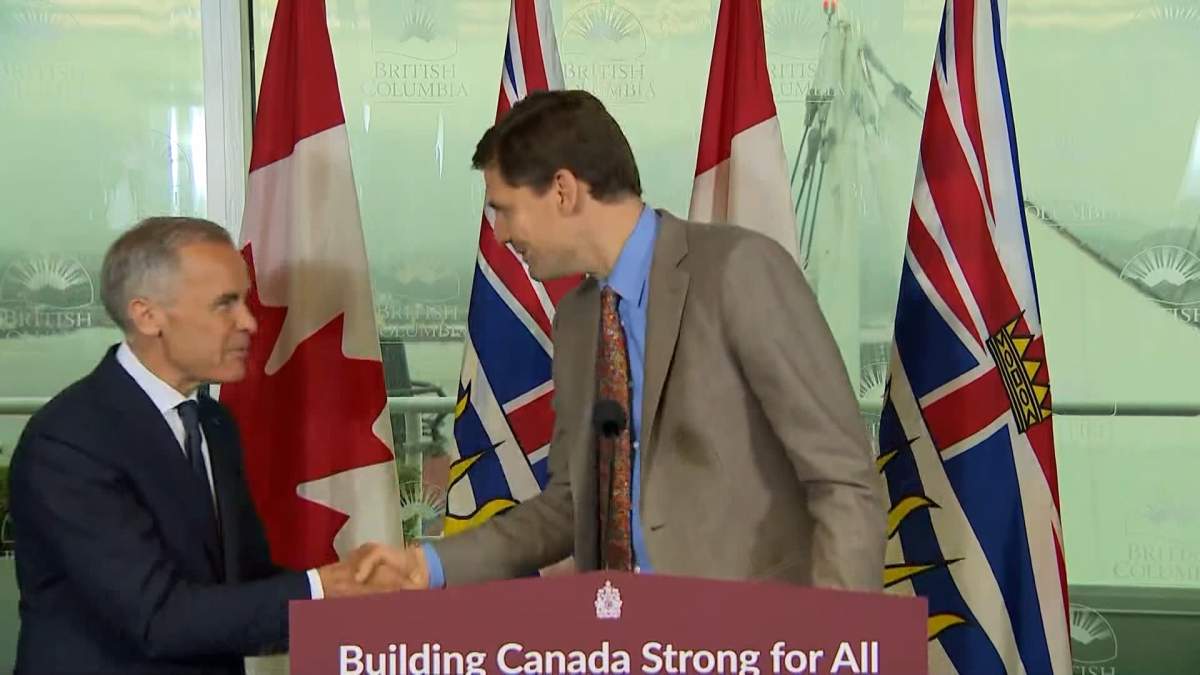
Prime Minister Mark Carney and British Columbia Premier David Eby shake hands following a joint press conference in Vancouver on Thursday.
Global NewsThe signing of the MOU comes seven months after the prime minister signed a separate MOU with Alberta Premier Danielle Smith that committed the two governments to work together toward construction of a the new pipeline.
That MOU included a July 1, 2026, deadline for Alberta to submit its formal proposal for the pipeline to the federal Major Projects Office and provides an Oct. 1, 2026 deadline for the federal government to designate the project as being in the national interest.
Asked what route the new pipeline could take now that Ottawa has agreed to keep the tanker ban in place, Carney said more details would be revealed at a Thursday evening announcement with Alberta Premier Danielle Smith in Calgary, during which Smith’s office said she would provide details about a “new one-million-barrel-per-day” pipeline.

Alberta Premier Danielle Smith, Federal Finance Minister François-Philippe Champagne and Calgary Mayor Jeromy Farkas take part in the "first flip" on Thursday morning, marking the traditional kickoff to Calgary Stampede celebrations.
Global NewsThe agreement about the pipeline is just one part of billions of dollars Ottawa is committing to spend in the MOU to support the development, modernization and expansion of a wide range on industries, projects and programs in the province, ranging from the expansion of the Red Chris mine in northern B.C., to completion of the George Massey Tunnel Replacement Project, financial support for the North Coast Transmission Line, along with steel manufacturing, the softwood lumber industry, deep water ports, shipbuilding, affordable child care and protecting the environment.
It was described by the prime minister as “a landmark Canada, British Columbia Cooperative prosperity agreement.’
“British Columbia is Canada’s gateway to the world’s fastest growing markets. British Columbia’s power grid produces amongst the cleanest and most reliable, affordable electricity in North America. B.C. is a leader in mining, production of gold, zinc, copper and well beyond. This great province has one of the world’s most educated and skilled populations. And so it’s on that exceptional foundation that Premier Eby and I are committed to build a stronger, more resilient, more independent province and country,” Carney said.
“This agreement is comprehensive, it’s ambitious, and it will help transform the entire Canadian economy. So it’s not just about one province, the entire Canadian economy, and will help fund the public services on which Canadians rely.”
Northwest B.C. groups said they are grateful and relieved by Thursday’s announcement confirming that the oil tanker ban will remain in place.
“For over 50 years, northern communities, Indigenous Nations, commercial and recreational fishers, businesses, conservation organizations, and residents worked together to secure permanent protection from crude oil tankers on the North Coast,” Des Nobels, chair of Friends of Wild Salmon said in a statement.
“Today’s commitment recognizes the importance of the region and risk of oil supertankers in our dangerous waters.”
However, there is still concerns about a marine oil spill off the B.C. coast.
“An oil spill anywhere along the B.C. coast threatens the salmon, marine wildlife, coastal economies, and communities that depend on healthy oceans,” Nikki Skuce, director of Northern Confluence said in a release.
“Everything is connected–from the headwaters to the estuaries, from the north to the south coast–and new pipeline and tanker proposals put it all at risk.”

Prime Minister Mark Carney and Alberta Premier Danielle Smith celebrate their signing of a "Memorandum of Understanding" on construction of a new pipeline to the west coast during a ceremony in Calgary in November 2025.
Global NewsWhile a new pipeline proposal has now been submitted, the project is also linked to the proposed Pathways Project, a multibillion-dollar carbon capture and storage initiative backed by the Oil Sands Alliance, a group that includes Canadian Natural Resources Ltd., Cenovus Energy Inc., Imperial Oil Ltd., Suncor Energy Inc. and ConocoPhillips Canada.
The project aims to reduce oilsands emissions by 16 million tonnes annually by 2045. Plans call for more than 650 kilometres of pipeline linking more than a dozen oilsands facilities to a carbon storage hub near Cold Lake, Alta., where captured carbon dioxide would be stored underground.
— with files from Global News’ Sean Previl and The Canadian Press.
© 2026 Global News, a division of Corus Entertainment Inc.






 Ad Choices